- The Distress Desk
- Posts
- Texas Gov't Code § 51.903: Invalidating Fraudulent Title Documents
Texas Gov't Code § 51.903: Invalidating Fraudulent Title Documents
An expedited legal process that Texas real estate investors can use to remove certain fraudulent documents from title.

Jeremy Nash
May 01, 2025
You've found the perfect deal. The numbers work, the seller is motivated, and you're ready to close. Then you get hit with a surprise—there’s a fraudulent memorandum of contract, lien, or other document on title for the property.
What do you do?
The conventional wisdom says you have two options: pay a "ransom" to whoever recorded it for a release, for example, or file a lawsuit to quiet title. Both approaches eat away at your time, money, and momentum in the deal.
But there's a third option that most investors—and even many attorneys—don't know about: Texas Government Code § 51.903.
This powerful statute creates an expedited, ex parte procedure to identify and invalidate documents that are, on their face, patently fraudulent. No long drawn-out legal battle. No crazy legal bills. Just one precision-guided legal filing and then the judge’s ruling.
In this issue, I'll walk you through what § 51.903 is, why it exists, and when it works best for real estate investors. This knowledge alone will put you ahead of everyone else.
For paid subscribers, I am also providing a step-by-step strategy guide, templates, and access to our AI assistant to ask questions beyond the scope of this newsletter.
Why This Matters to Your Bottom Line
First, as real estate investors, we're in the business of making smart bets with our money. But fraudulent recordings create a unique kind of uncertainty that can kill otherwise viable deals:
Time Uncertainty: Negotiating with the person who recorded the document can be unpredictable, especially if they know they have leverage. Traditional lawsuits present the same kind of uncertainty—it can be impossible to meaningfully forecast how long litigation will take to resolve.
Cost Uncertainty: Along the same lines, the "ransom" demanded by the person who recorded the document is inherently unpredictable, as are the total attorney fees and court costs that a lawsuit will run you.
These are essentially underwriting challenges that can prevent us from making an informed business decision about an investment opportunity. In the absence of a clear business plan for a property, many investors simply walk away from opportunities—torching the money spent to generate that lead and the potential return on that investment.
Texas Government Code § 51.903 offers a strategic alternative that can dramatically reduce the time, cost, and uncertainty of dealing with fraudulent documents. When used correctly, this tool can transform what might have been a deal-killer into a low-cost and low-stakes bump in the road.
Understanding § 51.903: What It Is and Why It Exists
The Problem § 51.903 Solves
Texas Government Code § 51.903 was enacted in 1997 to address a growing problem: the filing of fraudulent judgment liens and other baseless documents that purported to create liens or claims against property. These filings were clogging court systems, harassing property owners, and disrupting legitimate commerce.
The legislature created § 51.903 as a "statutory scheme to quickly identify and remove liens and encumbrances that are on their face patently without basis in recognized law." The goal was to provide an expedited process that focused narrowly on the facial legitimacy of documents, without getting bogged down in resolving underlying disputes.
Key Elements of § 51.903
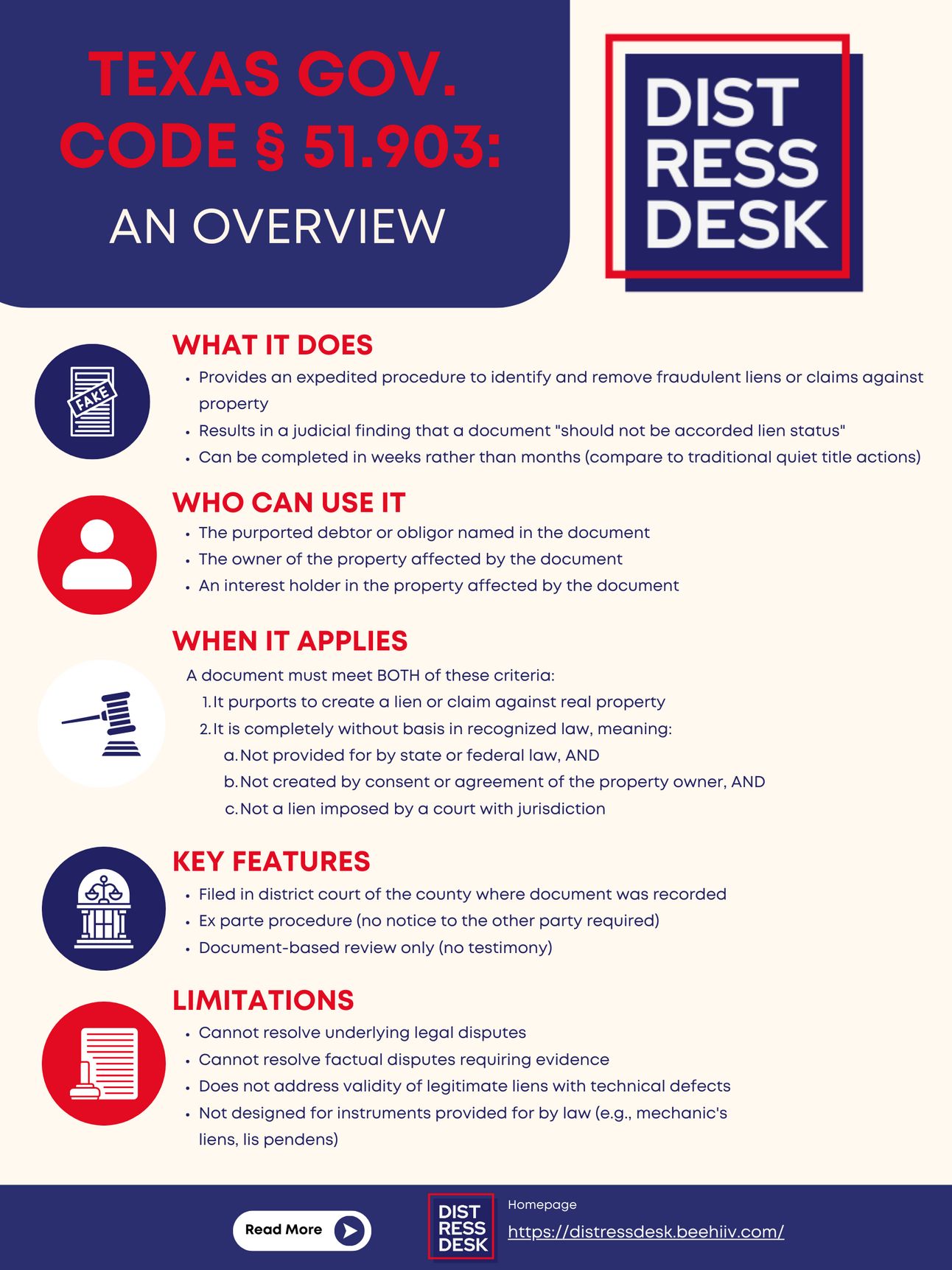
Who can use it: A person who is the purported debtor, property owner, or interest holder who believes a document purporting to create a lien or claim against their property is fraudulent.
What it determines: Whether the document is "fraudulent" under § 51.901(c)(2), meaning it purports to create a lien or claim against property and all the following are true:
Not a document provided for by state or federal law
Not created by consent or agreement of the owner (if required by law)
Not a lien imposed by a court with jurisdiction
How it works: The process is ex parte (without notice to the other party), based solely on document review without testimony, and results in a judicial finding of whether the document should be accorded lien status.
Limitations and the Narrow Definition of "Fraudulent"
It's important to understand what § 51.903 can and cannot do. The court cannot rule on the validity of the underlying claim or lien itself, or address substantive evidentiary issues. Your motion must acknowledge that it's not seeking to invalidate a legitimate lien.
Additionally, "fraudulent" has a very specific statutory meaning in this context—not what it means in everyday conversation. A recorded document is "fraudulent" under § 51.903 only when it purports to create a lien or claim against property and is completely without basis in law, consent, or judicial action (see Key Element 2, above).
Courts apply this standard to identify documents that are patently invalid, not documents with mere technical deficiencies that still fit within recognized legal frameworks. This practical interpretation is crucial to understanding when § 51.903 will—and won't—work for you.

When To Use § 51.903 (And When Not To)
The key to successfully using § 51.903 is understanding its limited scope. This process works best when the fraudulent nature of the document is apparent on its face, without needing to resolve factual disputes or assess the merits of underlying claims.
Strong Fact Patterns for § 51.903
✅ Document Types Not Recognized By Texas Law: Instruments with made-up names ("Land Patent Claims," "Sovereign Citizen Liens") or that attempt to create rights not recognized in Texas statutes have been successfully challenged as not "provided for by the constitution or laws of this state."
✅ Documents From Non-Existent Parties: Documents purportedly signed by deceased individuals (verifiable through death certificates) or executed by non-existent corporate entities (verifiable through Secretary of State records) can be successfully challenged without requiring testimony because consent and agreement are impossible.
✅ False Judicial or Legal Authority: Self-created "court orders," documents referencing non-existent court cases, or instruments falsely claiming to be official governmental documents have been successfully invalidated under § 51.903 as facially fraudulent.
Weak Fact Patterns for § 51.903
❌ Documents Provided For By Law With Technical Defects: Courts have consistently held that documents like mechanic's liens, lis pendens, and deeds of trust are "provided for by law" even if they contain technical defects, inaccuracies, or insufficient details. Because these documents fall within one of the legitimate categories (being provided for by law), they cannot be deemed fraudulent under the courts' practical application of § 51.903.
❌ Challenges Requiring Evidence Beyond the Documents: § 51.903 motions cannot succeed when they depend on testimonial evidence about forgery, fraud, lack of authority, or disputes about the underlying facts of a transaction.
❌ Documents That Transfer Rather Than Create Claims: Assignments of mortgages, deeds of trust, or other existing liens merely transfer interests rather than creating new claims against property and are outside the scope of § 51.903.